


The Educational Benefits of Water Play at School
Water play is not just a splashing good time—it’s a crucial element in early childhood education that supports holistic development. According to a study published in the Journal of Early Childhood Research, children engaged in regular water play activities showed a 32% improvement in problem-solving skills compared to those with limited exposure (Trawick-Smith, 2019). Furthermore, research from the National Association for the Education of Young Children (NAEYC) indicates that water play can enhance language development by up to 25% in preschoolers.
The versatility of water as a learning tool is unparalleled. A survey conducted by the Early Years Alliance found that 89% of early childhood educators consider water play essential for sensory development. Additionally, the British Association for Early Childhood Education reports that water play activities can increase children’s engagement in STEM-related learning by up to 40%.
In this comprehensive guide, we’ll dive (pun intended) into the multifaceted benefits of water play across various developmental domains:
- Physical Development: We’ll explore how water play enhances both fine and gross motor skills, with specific activities tailored for different age groups.
- Cognitive Growth: Discover how water play fosters mathematical thinking, scientific exploration, and problem-solving abilities.
- Social-Emotional Learning: Learn about the social skills and emotional intelligence nurtured through collaborative water play activities.
- Language and Creativity: Uncover the ways water play stimulates vocabulary expansion and imaginative thinking.
- Age-Appropriate Activities: We’ll provide a range of engaging water play ideas suitable for children from infancy through to school age.
- Curriculum Integration: Find out how to seamlessly incorporate water play into your EYFS curriculum, complete with a sample lesson plan.
- Safety Considerations: Essential tips for ensuring safe and enjoyable water play experiences.
Physical Development and Water Play
Fine and Gross Motor Skills – Water play provides numerous opportunities for children to develop both their fine and gross motor skills. Manipulating a sponge, pouring water from a jug, or stirring with a paddle all help children to refine their fine motor skills and hand-eye coordination. On a larger scale, actions like scooping, lifting, or carrying water can enhance gross motor skills and build physical strength.


Sensory Stimulation – Water play is an excellent sensory activity, providing tactile experiences that are essential for a child’s sensory development. The sensation of water, the contrast of wet and dry, and the effects of temperature help children build a rich vocabulary of sensory experiences.
Cognitive Development and Water Play
Mathematical Concepts – Water play can provide a hands-on approach to understanding basic mathematical concepts. Children can explore concepts such as volume, density, and measurements by pouring, filling, and emptying containers of different sizes and shapes.
Science Exploration – Children can learn about physics and natural science concepts during water play. They can observe how water flows, understand the concept of buoyancy as they see which objects float or sink, and learn about the water cycle.


Social-Emotional Development and Water Play
Collaboration and Sharing – Water play often takes place in a communal setting, providing a platform for social interaction. Children learn to share resources, take turns, and collaborate on water-based tasks, fostering their social skills and emotional intelligence.
Self-Confidence and Independence – Completing water-based tasks successfully can build a child’s confidence and independence. Whether it’s pouring water without spilling, or making a toy boat float, these small victories can significantly boost a child’s self-esteem.
Creativity and Imagination in Water Play – Water play can stimulate a child’s imagination and creativity. A pool can become an ocean, a toy duck can turn into a sea monster, and a small boat can embark on epic adventures. This imaginative play is vital for a child’s cognitive development and storytelling skills.
Integration of Water Play into the Curriculum
Educators can integrate water play into their curriculum in various ways:
- Thematic Learning: Use water play to reinforce themes. For instance, during a lesson about marine life, children can play with toy sea creatures in the water.
- Sensory Tables: Use sensory tables with different materials, including water, for children to explore.
- Outdoor Learning: Take advantage of outdoor spaces for larger scale water play activities.


Water Play Activities for Every Age Group
Water play, while seemingly simple, offers robust educational benefits. It contributes to physical and cognitive development, fosters social-emotional skills, and stimulates creativity and imagination. By incorporating water play into their curriculum, teachers can provide a fun, engaging, and enriching learning experience for children. Water is nature’s most engaging sensory toy for children. Let’s explore inspiring water play activities tailored to each age and the developmental benefits they nurture.
Newborn Water Play (0-6 Months)
Even newborns can enjoy water play during bath time. Gently splashing or running warm water over an infant’s skin allows for sensory exploration in a safe, supervised environment. Providing soft mesh bath toys, plastic bottles, or floating bath mats for visual tracking and grasping develops hand-eye coordination. Bath time water play benefits include:
- Building trust between caregiver and child through nurturing touch
- Stimulating the senses of touch, sight, and hearing through warm water, toys, and soft voices
- Promoting body awareness and comfort with water
Activities:
- Pour water gently over infant’s back, arms, legs
- Make eye contact, smile, and talk to baby during bath
- Provide brightly colored mesh toys for grasping and visual tracking
Water Play For 6-12 Months
Around 6 months old, babies can sit supported in just an inch or two of water, discovering the magic of splashing. Offer a variety of floating bath toys, cups, and containers for pouring and dumping. Set up a water table or kiddie pool outside on warm days for puddle play. Garden sprinklers, spray bottles, and sensory bags allow for wet and wild experiments. Benefits include:
- Strengthening hand-eye coordination and fine motor control
- Encouraging cause-and-effect understanding and problem solving
- Fostering sensory learning and curiosity through interactive play
Activities:
- Let baby splash and pour water from containers into buckets
- Provide stacking cups and bath toys for grasping and manipulating
- Safely expore spray bottles and water tables for puddle play

Toddler Water Play (1-2 Years)

Toddlers love getting their hands wet for sensory exploration and open-ended experimentation. Provide containers, cups, funnels, and scoops in a water table or kiddie pool, both indoors and out. Show them how to fill buckets, pour into funnels, and mix with sensory materials like beans or rice. Sit beside toddlers to supervise splashing fun. Benefits include:
- Supporting cognitive development through cause-and-effect play
- Promoting fine motor skills by grasping, lifting, dumping, and scooping
- Allowing autonomy and creativity through child-directed play
Activities:
- Fill and dump buckets, cups, bottles endlessly at a water table
- Mix in beans, rice, or pom poms for scooping and straining
- Provide lots of containers and toys for filling and pouring practice

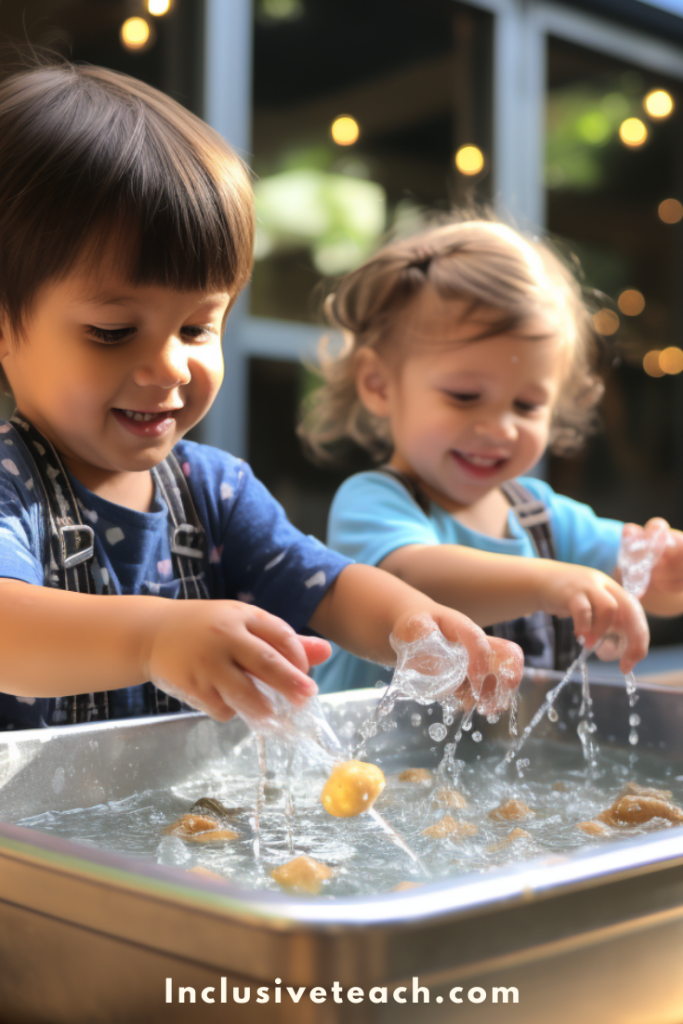
Preschooler Water Play (2-4 Years)
As preschoolers gain confidence, their experiments get more complex. Provide tubes, funnels, pipettes, measuring cups and spoons for sensory science explorations. Talk about concepts like empty/full, sink/float, heavy/light as they engage. Set up a combined water and sand table for squishy, wet fun. Benefits of water play for the EYFS age group include:
- Stimulating early math and science concepts through hands-on play
- Developing social skills like cooperation, sharing, and turn-taking
- Allowing independent discovery and problem solving
Activities:
- Have preschoolers race boats down a water trough
- Add droppers for eye-hand coordination practice
- Provide cups and funnels for pouring “experiments”
Water Play for 4-5 Year olds
School-aged children enjoy more complex outdoor water play EYFS challenges. Set up a DIY car wash station with buckets, sponges, and rags. Provide gutter pieces or pea gravel for engineering drainage systems. Experiment with hoses, sprayers, water balloons, and outdoor water toys to beat the heat. Benefits include:
- Encouraging creative problem solving and early engineering
- Developing literacy skills in describing play experiences
- Coordinating gross motor movements for active play
Activities:
- Set up a car wash station for water play clean up
- Provide tools to design water troughs and drainage
- Enjoy outdoor hose play on hot days

Fun water play ideas for older children:
- Water balloon games – Have kids fill up balloons and play games like water balloon toss or water balloon pinata. This develops cooperation and motor skills.
- DIY sprinklers – Let kids make their own sprinklers by poking holes in reused plastic bottles or other containers. They can then experiment with spray patterns.
- Rain gutter regatta – Float toy boats down a raingutter ‘river’ propped on an incline. Kids can design and race their boats.
- Water transportation – Provide tubes, pipes, funnels etc. and challenge kids to transport water from one container to another in creative ways.
- Water science – Set up simple science experiments like creating a rainbow, exploring surface tension, or dissolving materials. Have kids predict outcomes and record results.
- Outdoor obstacle course – Set up a course in the yard with sections like sprinkler dashes, water table stops, slip-n-slides. Time kids going through the wet obstacles.
- Water colors – Provide liquid watercolors or food coloring for kids to mix and swirl colorful designs on paper, sidewalks, etc.
- Frozen excavation – Freeze small toys in ice cubes or blocks of ice and let kids chisel away to free the “fossils”.
- Bubble play – Encourage kids to mix their own bubble solutions and experiment with giant bubble wands, bubble snakes, etc.
An Example Outdoor Water Play Lesson Plan for EYFS

Here is an example early years lesson plan for water play activities linked to EYFS learning outcomes:
Lesson: Splish Splash Water Play
Overview: This water play lesson allows EFYS children to explore various learning concepts through sensory-rich, open-ended water play. A small group of children are making a river with water and sand and floating boats down the river. how is their cognitive development supported by this play?
Learning Objectives For Outdoor Water Play EYFS:
- Fine Motor Skills (Physical Development – Moving and Handling) – Children will practice eye-hand coordination by filling containers and squirting water with turkey basters.
- Volume Concepts (Mathematics – Numbers) – Children will experiment with measuring and comparing amounts of water using different sized/shaped containers.
- Language Development (Communication and Language – Speaking) – Discussion of water play experiences, sensations, and observations will be facilitated.
- Scientific Concepts (Understanding the World – The World) – Children will observe cause and effect of sinking/floating objects and make predictions.
- Social Skills (Personal, Social and Emotional Development – Making Relationships) – Children will be encouraged to cooperate, share resources, and play together during the activities.
- Problem Solving (Mathematics – Shape, Space and Measure) – Children will be challenged to create ramps and water channels to direct the flow of water.
- Risk-Taking (Physical Development – Health and Self-Care) – Children will be supported in taking safe risks by splashing, pouring, and experimenting with the water.
- Imaginative Play (Expressive Arts and Design – Exploring and Using Media and Materials) – Open-ended materials and scenarios will encourage unstructured creative water play.
- Following Directions (Literacy – Reading) – Step-by-step instructions will guide children in completing specific water tasks and experiments.
- Self-Confidence (Personal, Social and Emotional Development – Self-Confidence and Self-Awareness) – Independence and creativity during water play will be encouraged and praised.
The key is providing engaging water play that encourages curiosity, problem-solving, cooperation and creative thinking as kids grow. Water play stimulates growing minds while keeping kids cool and engaged at every age. Get creative with activities tailored to each stage, if it doesn’t work just try something else.
