

Our Charles Darwin: Voyage of the Beagle multi-sensory story was originally created for a Key Stage 4 class, linking with the Cornerstones Curriculum topic “Darwin’s Delight.” This story was designed as part of our Stage 5 immersive storytelling series, which features more advanced language, layered imagery, and opportunities for deeper exploration. While the vocabulary and themes stretch beyond early developmental levels, they’re still accessible with the right scaffolding.
The structure and pacing were written with SLD learners in mind, offering a rhythmic and engaging narrative enriched by tactile, auditory, and visual stimuli. However, with a few simple tweaks, such as simplifying phrases, extending pauses, or using more intensive sensory input, it can be meaningfully adapted for pupils with PMLD or those working at pre-formal levels. This story encourages learners to explore big ideas like discovery, nature, and change, through concrete, hands-on experiences that invite curiosity and wonder.

The Darwin: The Voyage of the Beagle Sensory Story is part of our sensory story collection all available to download using the link above.
Darwin: The Voyage of the Beagle Sensory Story
On a bustling quayside A ship was ready to sail.
Among all the sailors stood a man at the rail.
He was ready for adventure, to travel the world.
The sleek wooden ship rocked as the sails unfurled.
The ship left Devonport with a following breeze.
The Beagle was off, bravely sailing the seas.
A cold December morning in 1831.
The voyage of discovery had finally begun.
The HMS Beagle a tall masted ship
The captain was reading maps for the trip
The ship kept on rolling, wave after wave
A seasick scientist was trying to be brave
After hard weeks at sea the Beagle saw land
Darwin couldn’t wait to step foot on the sand
The island was an exotic and beautiful sight
With trees and flowers colourful and bright.
There were animals and birds he’d never seen.
The brightest of colours red, purple, green.
They flew through the sky and nested in trees.
Taller than the ship that swayed in the breeze.
On one rocky island, volcanic and serene
Were tortoises older than he’d ever seen
With wrinkly skin and the hardest of shells
They were huge almost the size of church bells
He walked through jungles and rivers and streams.
Seeing sights that were beyond his wildest dreams.
On beaches and mountains he hunted for fossils.
Of ancient beasts that could be described as colossal.
After 5 years the Beagle returned to England
In Darwin’s cabin his collection was crammed
Darwin started writing a world changing Book
About what he discovered on the journey he took
The origin of species, and natural selection.
Theories based on his fantastic collection.
Darwin is famous for the theory of evolution.
This is his greatest scientific contribution.

Download the Free Charles Darwin Sensory Story PDF
Click the button below to download the multi-sensory story as a free PDF booklet for PMLD or SLD learners. Younger children in EYFS may also enjoy it. I would love to hear how you have used it in your classrooms. This story is provided for free but a share would be appreciated! If you want to use it on your school website, please link to this page not the file. Thank you.
Suggested Sensory Resources
These should be chosen according to the sensory profile or interests of your learners. Depending on the need type, allergies and known aversions, you may want to swap these out for other resources.
- Blue material
- Canvas material
- Wood
- Flower fragrance
- Exotic fruit
- Biscuits
- Maps/large sheets of paper
- Water spray
- Large leaves/green paper
- Tortoise shell effect material
- Flowers
- Feathers
- Seagulls
- Sea sound effect
- Quayside sound effect
- Creaky boat sound effect
Darwin’s Big Adventure: Adapted Sensory Story for PMLD Learners
1.
A big brown boat is ready to go.
(Swish blue fabric in front of learner like sea waves)
2.
The sails go up, the wind starts to blow.
(Fan face gently or use a hand-held fan)
3.
The boat rocks left, then it rocks right.
(Gently rock the learner side to side or use a wobble cushion)
4.
Darwin feels sick, but he holds on tight!
(Tap chest gently with hand or provide tight hand squeeze)
5.
“Land ahead!” the captain shouts.
(Play a seagull or port town sound effect)
6.
Darwin steps down, he looks all about.
(Put rough wood or sandpaper under hands for ‘dock’)
7.
He sees red flowers and tall green trees.
(Offer a floral scent or show large fake leaves)
8.
Birds fly fast in the sky and breeze.
(Flutter feathers gently near arms or cheeks)
9.
A slow old tortoise walks past his toes.
(Place cool, bumpy shell-like material near feet)
10.
Its shell is hard, its legs move slow.
(Offer a hard, patterned object for touching)
11.
Darwin finds fossils in rocky ground.
(Give stone or fossil replicas to hold or knock together)
12.
He listens to nature — every sound.
(Use jungle animal or water stream sound effects)
13.
After five long years, the ship goes back.
(Shake blue cloth again for sea, spray light water mist)
14.
His room is full of treasures in a sack.
(Explore a box or bag filled with chosen favourite textures)
15.
He writes a book about all he’s seen.
(Show book with bright cover, let learner turn pages)
16.
He tells the world what life might mean.
(Offer celebratory clap, light show, or sound cue)
Darwin EYFS/SEN Teaching Activities
🐚 1. Explore the “Specimen Collection” Sensory Tray
Objective:
Introduce learners to Darwin’s discoveries through tactile exploration and categorisation.
Setup:
Create a themed sensory tray or box with:
- Fossil replicas or dinosaur toys
- Shells and stones
- Feathers
- Leaves and flowers (real or artificial)
- Animal figurines
How to Use:
- Let pupils explore freely or with guided prompts like “Can you find something hard/soft/smooth?”
- Group items by texture, colour, or type (e.g. “plants” vs “animals”).
- Use AAC boards, PECs, or Makaton to label findings.
PMLD Adaptation: Present one item at a time with clear commentary, allow hand-under-hand exploration, and give time to respond non-verbally.
🌊 2. Make the Beagle Set Sail! – Water Play Activity
Objective:
Recreate the Beagle’s voyage while developing motor and cause-effect skills.
Setup:
- Use a shallow tray filled with water
- Add blue fabric, toy boats, and wind (from fans or straws)
- Add drops of sea-scented oil (optional)
How to Use:
- Let pupils float boats and watch the movement
- Use switches to activate a fan or sound effect
- Pour water from jug to tray to simulate the sea storm
Extension: Chart the Beagle’s route on a simplified world map and match boat movement to locations.
🐢 3. Tortoise Shell Textures – Matching and Mark-Making
Objective:
Develop tactile discrimination and early mark-making using the tortoise theme.
Setup:
- Provide materials that resemble shells: corrugated cardboard, bubble wrap, ridged plastic, sandpaper
- Outline tortoise shapes on card
- Offer crayons, chalk, or paint dabbers
How to Use:
- Let learners explore textures first
- Encourage them to choose one and press/rub to make shell patterns
- Support name labelling or sentence building e.g. “The shell is bumpy.”
PMLD Adaptation: Offer hand-over-hand support or pre-prepared sensory boards with embedded materials.
🦜 4. Birdwatching Discovery Bottles
Objective:
Encourage visual engagement and colour recognition.
Setup:
Create discovery bottles (clear bottles or jars) with:
- Feathers, sequins, beads
- Glitter in water or gel
- Mini bird toys or images inside
How to Use:
- Shake, roll, or spin bottles — “What colours can you see?”
- Link to the line “Birds fly fast in the sky and breeze.”
- Pair with sound buttons that play bird calls
Autism-Friendly Adaptation: Provide noise-cancelling headphones if needed, or let learners explore without auditory input.
📘 5. Darwin’s Travel Journal – Personalised Book Making
Objective:
Support communication, sequencing and ownership of learning.
Setup:
Make a simple A4 folded booklet with 3–5 pages titled:
- “Where I Went”
- “What I Found”
- “What I Touched”
- “What I Saw”
- “What I Liked Most”
How to Use:
- Add printed photos from the session, symbols, or drawings
- Use eye-pointing, voice output devices, or symbols to choose content
- Allow scribbling, sticking, or colouring for creative contribution
Extension: Share finished journals at home or in a class show-and-tell.
On The Origin of Species Illustrated book.
This wonderfully illustrated book based on the origins of species by Charles Darwin is great for getting key facts about evolution across. Retold by Sabina Radeva.

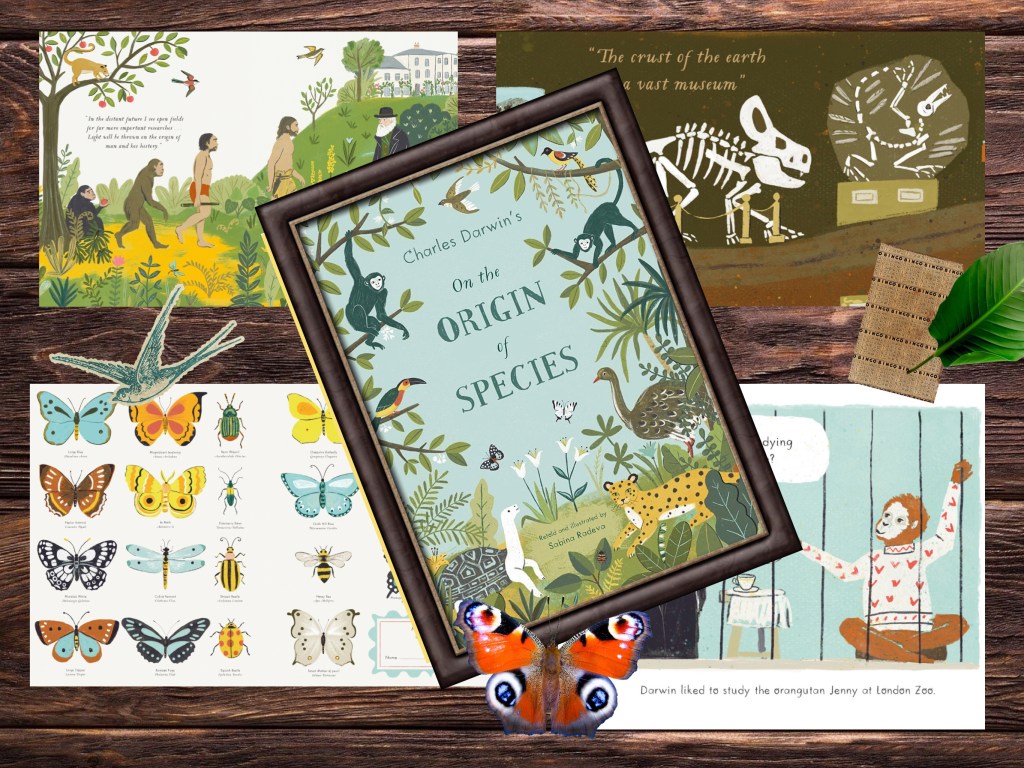
Origin of the species book
Discover more from Special Education and Inclusive Learning
Subscribe to get the latest posts sent to your email.